

The ACLU of Alaska works tirelessly to ensure that our state’s jails and prisons comply with federal and state constitutional law, and that all Alaskans who have interacted with the criminal legal system have the opportunity to exercise their full legal rights. Almost half of people incarcerated in Alaska are eligible to vote. And, in Alaska, even people who lose the right to vote become eligible to vote again once they are unconditionally discharged from Department of Corrections (DOC) supervision.
As people across the country gear up to participate in primary and general elections, we are sharing resources to clarify voting rights and voting status for people who have been convicted of crimes and people who are currently incarcerated.
Voting while incarcerated
If you are currently incarcerated or helping an incarcerated loved one vote, here’s what you need to know.
Incarcerated people can vote, unless they have been convicted of a “felony involving moral turpitude.”
The list of felonies that disqualify an individual from voting can be found here. If a person has been convicted of a crime on this list, they may not vote in municipal, state, or federal elections from the date of the conviction until they are unconditionally discharged. Unconditional discharge means that you are no longer under any DOC custody or supervision, including prison, halfway houses, furlough, sentenced electronic monitoring, probation, or parole. Once a person is unconditionally discharged from all forms of supervision, they may register to vote if they are otherwise eligible.
Because it’s a conviction for a crime that makes someone ineligible to vote in Alaska, many incarcerated Alaskans are eligible to vote. Being charged with a felony involving moral turpitude does not make you ineligible to vote if you have not been convicted, even if you are incarcerated pretrial. Being convicted of a misdemeanor does not make you ineligible to vote in Alaska, even while you are incarcerated or on probation.
How to request an absentee ballot. A person who is incarcerated and eligible to vote can vote using an absentee ballot. Alaska’s absentee voting system allows eligible voters to receive a ballot by mail from the Division of Elections, fill it out, and return it by mail.
An incarcerated person who is eligible to vote can write to the Division of Elections to request an application for an absentee ballot. The application for an absentee ballot can also be used to register to vote if you are eligible but not yet registered to vote.
The mailing address for the Division of Elections’ absentee voting office is:
3651 Penland Pkwy, 2nd Floor, Anchorage, AK 99508-2034
Friends or family can print the application and mail it to the incarcerated person who can then fill it out and mail it to the Division of Elections. The application for an absentee ballot is available to print here. DOC policies 808.18 and 808.18a explain this process from DOC’s perspective.
Make sure to complete the absentee ballot application truthfully, accurately, and with the following in mind:
- The Division of Elections must receive your application at least 30 days before the election (or at least 10 days before, if you are already registered to vote). DOC can take time to process incoming and outgoing mail, so leave plenty of time to spare.
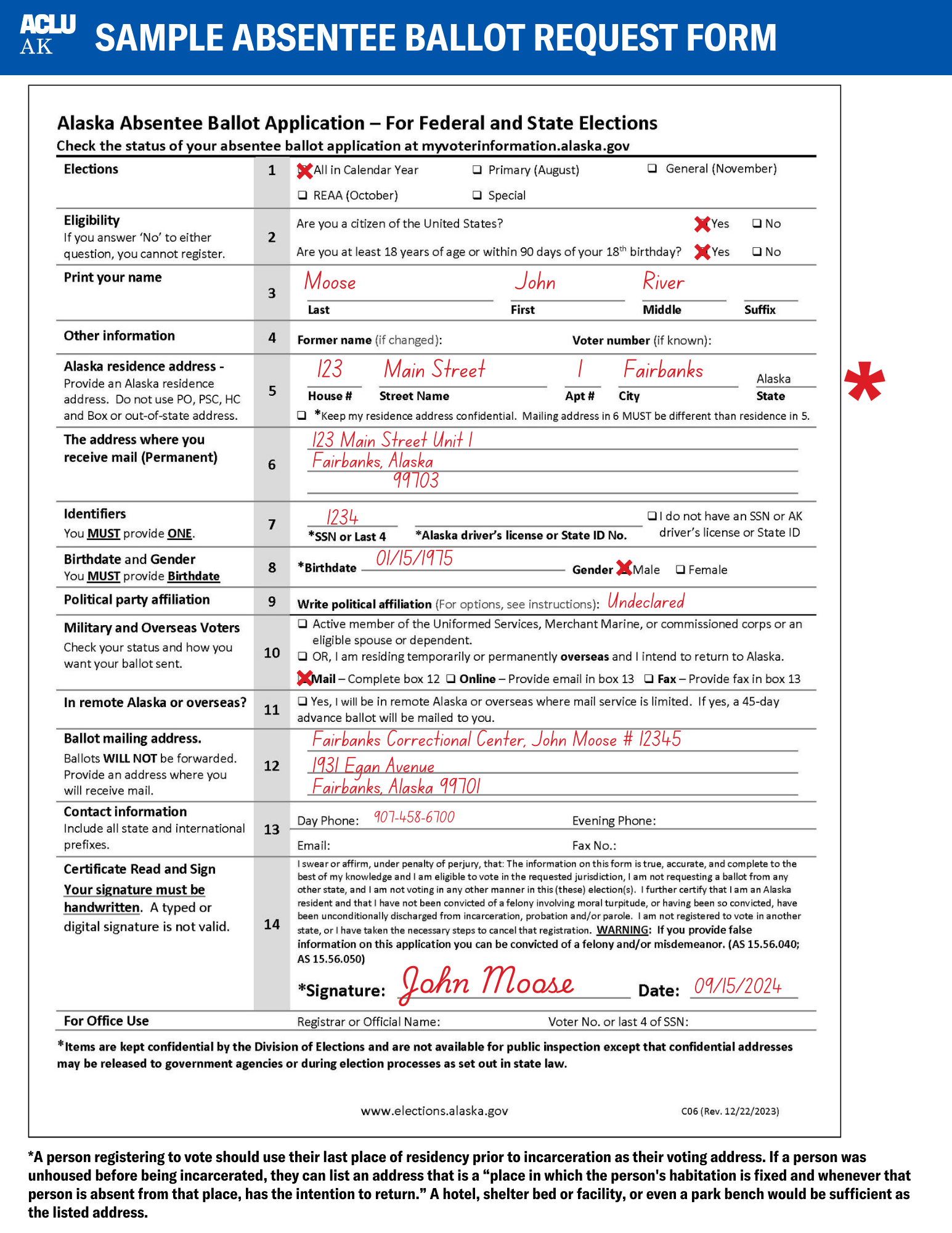
- A person registering to vote should use their last place of residence before incarceration as their “Alaska residence address” on the application form, not the correctional facility where they currently reside. If a person was unhoused before incarceration, they can list any address where they resided and intend to return. The Alaska Supreme Court has said that a hotel, shelter bed, or even a park bench would be sufficient for a voter residence.
- An incarcerated person may put their last place of residence prior to incarceration as “The address where you receive mail (Permanent).”
- The “ballot mailing address” should be the address of the jail or prison where the applicant is currently incarcerated. This is very important, because it ensures the ballot gets to the right place.
Here’s an example of how to fill out an absentee ballot application from a prison or jail facility in Alaska.
After you mail in your absentee ballot application, the Division of Elections should mail you an absentee ballot in a special envelope. Follow the Division of Elections’ instructions carefully when filling it out and mailing it back. DOC policy 808.18a says that DOC treats mail to and from Division of Elections as “privileged mail,” but that DOC will not send it out faster than other mail. Make sure to mail your ballot back with plenty of time to spare.
Voting after restoring your right to vote
In general, if you have not voted for a long time, you should check your voting status because you may need to register to vote again. Check your voter registration status online here.
If you lost your right to vote because of a criminal conviction, you regain the right to vote once you are unconditionally discharged. As explained above, a criminal conviction makes you ineligible to vote in Alaska only if it’s a conviction for a “felony involving moral turpitude,” and only until you are unconditionally discharged from all DOC supervision.
If you are unconditionally discharged and eligible to vote, DOC is supposed to send you a letter notifying you that your right to vote has been restored (see DOC policies 902.13 and 902.13a). If you receive this letter, make sure to keep it and any other paperwork that proves you have been unconditionally discharged. If you lose that letter, you may still register to vote; the Division of Elections typically confirms unconditional discharge directly with DOC instead of requiring you to provide paperwork as proof upfront. Make sure you have accurate information and are honest about your status.
How to register to vote after incarceration.
If you wish to vote after having your right to vote restored, you must register to vote. There are three options to register to vote after incarceration.
- Register to vote in-person at Division of Elections Offices, DMV Offices, Vocational Rehabilitation Offices, Participating Tribal Government Offices, Legislative Information Offices, United States Armed Forces Assistance Offices, Public Assistance Agencies, City or Borough Clerk’s Offices, Participating Public Libraries, or Voter Registrars. When you register to vote, you should bring your dismissal or discharge papers to prove you are no longer on probation or parole, if you have it. But as noted above, the Division of Elections typically does not require proof of unconditional discharge when you register to vote.
- Register to vote via mail. Print a paper form to complete and sign. Send the completed form by mail, fax, or email attachment to a Regional Elections Office.
- Register online. Register through Division of Elections’ online site.
Once your voter registration application has been approved, you may vote like any other registered voter.
Having issues with voting while incarcerated or navigating the elections process after incarceration? Please notify us by filling out our online intake form. If you are incarcerated or cannot access the online form, write to us at ACLU of Alaska, PO Box 90788, Anchorage, Alaska 99509.