
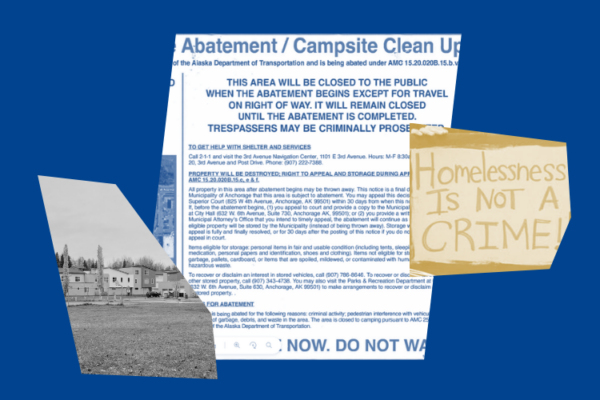
The ACLU of Alaska routinely monitors homeless encampment sweeps, sometimes known as abatements, to ensure that government actors are respecting the constitutional rights of unhoused Alaskans. Typically, sweeps are conducted by local governments. However, in the fall of 2024, community members alerted us to a sweep that looked different. This time, the encampment sweep was led by the State of Alaska’s Department of Transportation and Public Facilities (DOT&PF), an unlikely agency to intervene in a homeless encampment.
The ACLU of Alaska submitted a records request to DOTP&PF in January 2025 to better understand why the state agency was initiating encampment sweeps in Anchorage and Fairbanks. Over 1,100 pages of records were produced, and our attorneys found three critical takeaways regarding the State’s funding for sweeps and its authority to carry out these practices.
The following takeaways contain citations to the records that were produced and are available for download here.
In 2024, DOT&PF received authorization to spend $450,000 of emergency funding to conduct encampment sweeps and forcibly displace people living outside in Anchorage and Fairbanks. The cost of these sweeps far exceeds the cost of housing the people who were living in these areas. The Anchorage Coalition to End Homelessness (ACEH), for example, estimates that it costs $100 a day to shelter someone, and $85 a day to house them in the Next Step program.
DOT&PF was approved for $300,000 to address a series of encampments in Anchorage (pg. 444-445). It is unclear how many people were living at these encampments, but follow-up emails from Anchorage Police Department (APD) indicate that at least one location had "only about 5 to 7 people in the camp" (pg. 583). In Fairbanks, DOT&PF was approved to spend $150,000 to address one encampment of between 25 and 40 people (pg. 147-149). This means that the State spent anywhere between $3,750 and $6,000 per person in Fairbanks to clear an area and push unhoused people from one outdoor space to another.
At the time of the sweeps, there was no formal DOT&PF policy as to how to conduct them, and no internal agreement that they had the authority to do so. During the sweeps that were carried out by DOT&PF in 2024, the state agency did not have a policy on how to address encampments on state land (pg. 104, 998). While a policy was later established in April 2025, the sweeps that were carried out prior to the establishment of a policy were questioned internally by DOT&PF employees, who were concerned about the agency’s authority to conduct encampment sweeps (pg. 106, 379, 411, 998).
DOT&PF failed to follow the Municipality of Anchorage’s process for noticing an abatement, and enlisted Airport Police for additional law enforcement support. Records indicate that the Municipality of Anchorage offered to perform an abatement through a ten-day notification process, which was declined by leadership at DOT&PF (p.532, 589). Instead, DOT&PF gave encampment residents 72 hours' notice, based on their interpretation of a Ninth Circuit case Where Do We Go Berkeley v. Caltrans (2022) (pg. 589, 1052-1053).
However, the Caltrans case does not provide blanket justification for DOT&PF’s actions. That case held that 72-hours’ notice before a sweep is adequate for disability-law purposes, but it did not address whether such a short notice period would violate the due process clause. To the contrary, in Alaska, courts have held that a 72-hour notice period violates individual rights. In Engle v. Municipality of Anchorage, the Alaska Superior Court held that five days' notice is constitutionally inadequate under Alaska's Due Process Clause.
Ultimately, DOT&PF disregarded the local community’s process and brought Airport Police, the agency’s law enforcement arm, in Fairbanks to Anchorage to assist with its encampment removal efforts. The complete costs associated with transporting Fairbanks Airport Police across the state to carry out the Anchorage abatements are not included in the records.
Sweeps and abatements without connecting unhoused people to services or shelter are not a meaningful response to the housing crisis. Instead, these actions simply push homelessness down the road and out of the public eye without addressing its root causes or helping individuals take steps to secure stable and safe housing. In addition, these policies make no fiscal sense in a time when our state is facing severe financial challenges.
While city leaders across Alaska are working to address the housing crisis in Alaska, we must understand the role of the State of Alaska and how it is helping – or hindering - efforts to house Alaskans. DOT&PF records reveal key details that help us understand how state money is being allocated and where we can advocate for actions that are more fiscally responsible.
The ACLU of Alaska is committed to holding government accountable to Alaskans and transparently sharing information that can inform better decision-making around housing and homelessness in our state. Alaskans deserve housing-based solutions that address the root causes of homelessness, not band-aids that displace and criminalize some of our most impoverished neighbors.