In response to the Grants Pass v. Johnson Supreme Court decision in 2024, municipalities across the country are seeking to criminalize the actions of people who lack stable and secure housing. In Alaska, we have seen towns and cities follow this trend, proposing ordinances that ban behavior like sleeping and camping on public land, subjecting people experiencing homelessness to an array of punishment, from fines to arrest. These ordinances target unhoused people, threaten their constitutional rights, and fail to meaningfully address the housing issues that Alaskans face.
Anchorage and Palmer enact criminalization ordinances
In July 2025, the Anchorage Municipal Assembly introduced and passed AO No. 2025-74(S-2), an ordinance that makes it a misdemeanor for homeless residents to camp on streets, sidewalks, railroad tracks, and bridges, and within 200 feet of major trail systems. It also criminalizes camping within 500 feet of schools, playgrounds, childcare centers, and homeless shelters. The ordinance carries fines ranging from $250 to $500. It was passed despite overwhelming public opposition to the ordinance.
In July 2025, the City and Borough of Juneau Assembly introduced ordinance AO No. 2025-28 to make it a crime to sit, lie, stand, walk, or camp on a public path in a way that prevents other people from easily passing. That proposed ordinance sought to criminalize Alaskans who exercise their freedom of speech and assembly. Its sweeping language captured a broad range of activities and did not contain any exceptions for lawful speech and protest. After multiple rounds of public comments and testimony from residents who opposed the proposal, the Assembly tabled the proposed ordinance, meaning it failed to pass -- but could arise in the future.
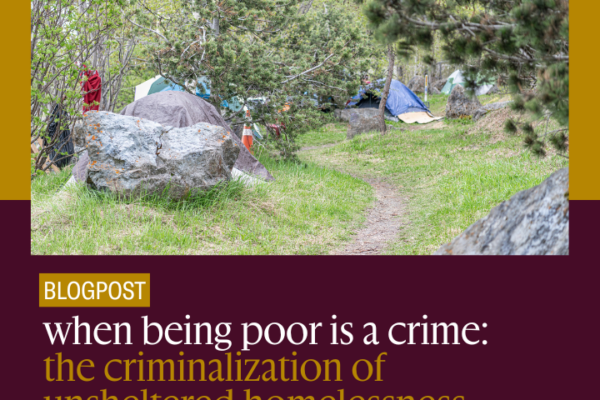
In late October, the Palmer City Council passed AO No. 2025-005, making it illegal to “camp” on all public property. The ordinance defined “camping” to include sleeping. The ordinance subjects people experiencing unsheltered homelessness in Palmer city limits to a fine of up to $300. Critically, there is no designated shelter in Palmer where people could go to avoid this fine. We are also monitoring a second proposal to make it illegal to sleep on all public rights-of-way, such as sidewalks, streets, or alleyways. This ordinance is with the Palmer City Attorney for further legal review.
Different outcomes, same public outcry
Although each of these communities had different responses to proposals to criminalize unsheltered homelessness, Alaskans consistently spoke out to support the rights of our neighbors. In Anchorage, Juneau, and Palmer, residents, both housed and unhoused, pointed to the constitutional issues with these kinds of ordinances. Alaskans questioned if these proposals would actually help address public safety and housing insecurity. Neighbors called for kindness, humanity, and accountability towards those experiencing unsheltered homelessness. People lined up to give their comments on the record; chambers were filled with concerned community members who opposed these ordinances.
“I think the proposed ordinance and the code changes therein demonstrate a lack of constitutional legal understanding, a lack of interest in real solutions for the issues that it’s attempting to address, and a clear lack of compassion for our neighbors,” said Ephraim Froehlich, chair of the Systemic Racism Review Committee in Juneau.
ACLU of Alaska staff members submitted comments on ordinances in all three communities, citing research showing the ineffectiveness of these types of proposals, their constitutional concerns, and, where appropriate, other suggestions to improve public safety.
We’d like to thank every Alaskan who came out to testify against these proposals.
As cities in Alaska put forward ordinances that could criminalize the act of existing in a public area, the stakes for our neighbors who are experiencing homelessness have never been higher. According to the Anchorage Police Department, 45 Alaskans died outdoor deaths in Anchorage in 2025; nearly 150 have died outside in the past three years in Alaska’s largest city. Many people are forced into impossible situations where they must prioritize survival in cold weather conditions over complying with the law.
It is crucial for decision makers in Anchorage, Juneau, and Palmer to hear community voices and concerns. Public testimony is one of the most powerful tools we have to protect civil liberties and demand accountability for the government. Every voice added to the record strengthens the call for policies that support people rather than punish them for their circumstances. Alaska's future depends on the engaged individuals who are willing to show up, speak out, and demand that all Alaskans are treated with dignity.
The ACLU of Alaska will continue to monitor communities across the state that pursue criminalization as an improper tool for addressing housing and homelessness concerns.